

Casting
Quality at Bridgnorth Aluminium begins with casting
Over many years, we have developed clean routes to support the most demanding applications.
Our casting capabilities enable us to produce rolling slabs internally, significantly reducing our environmental impact and improving our control over the quality and lead times of our products.
Slabs are formed from raw aluminium ingot, purchased from stringently approved suppliers, or scrap metal generated from our downstream process. These inputs are melted/re-melted in our furnaces, transferred to our casting moulds and finally cast to form rolling slabs.
We have sophisticated quality control systems to manage quality at the casting stage, and a dedicated cell team to ensure efficient production.
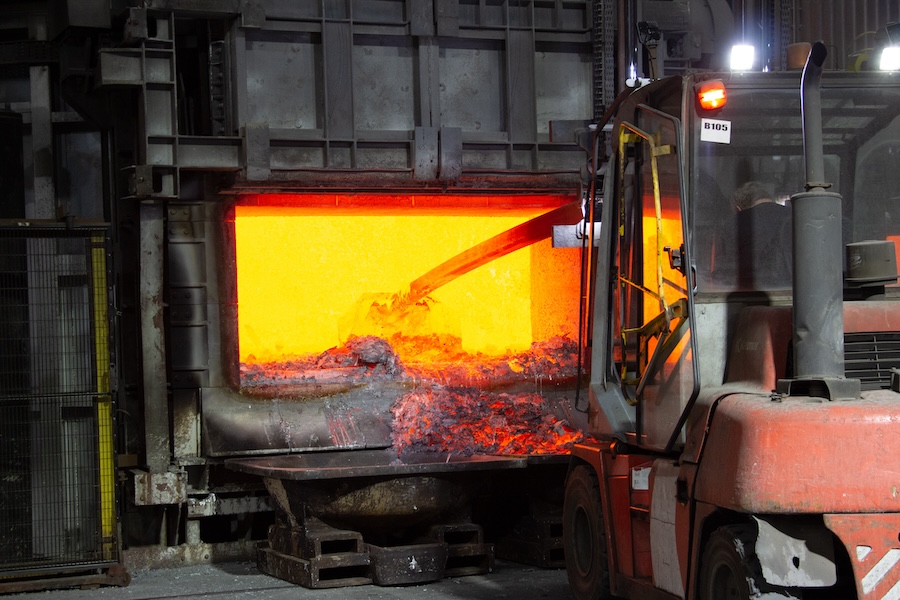
Our slabs not only supply our rolling mills - they reflect our commitment to a greener, more sustainable future.
Our casthouse plays a pivotal role in producing top-tier aluminium slabs.
The journey from raw materials to rolling slabs is a testament to our dedication to quality and sustainability. Our raw materials are sourced meticulously, either from stringently approved suppliers or from scrap metal generated within our downstream processes. We recycle aluminium to save energy and reduce the need for primary aluminium production, which is all part of our drive towards a reduced environmental footprint.
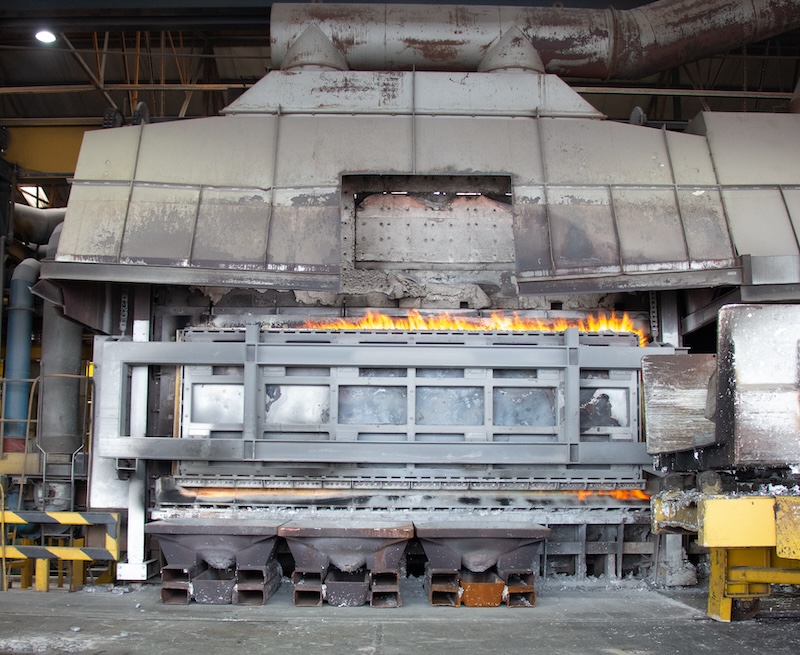
The entire operation is fully automated, minimising human interaction. It is controlled by PLC units with predefined recipes and parameters, guaranteeing employee safety, process consistency, and traceability to ensure product quality.
The process commences with the melting of aluminium raw materials in the melting furnaces. Advanced software operations, with a clear overview of the warehouse, will optimise the blending recipes to achieve the required chemical analysis. Once in a liquid state, the metal is transferred to the holding furnace for necessary alloying and purification treatment. The aim of this stage is to bring the alloy within specifications and to remove impurities and inclusions generated by previous stages.
A compact degasser removes hydrogen absorbed in the liquid metal during the liquid’s transfer to the casting pit. The metal is then cast into slabs using suitable moulds following a DC casting process.
Get in touch
Contact us to discuss any of our products and services.
If you would like more information about our lithographic aluminum or any of our other products please complete the enquiry form and a member of our team will reply as soon as possible.
Alternatively you can call us on +(44) 1746 788 111